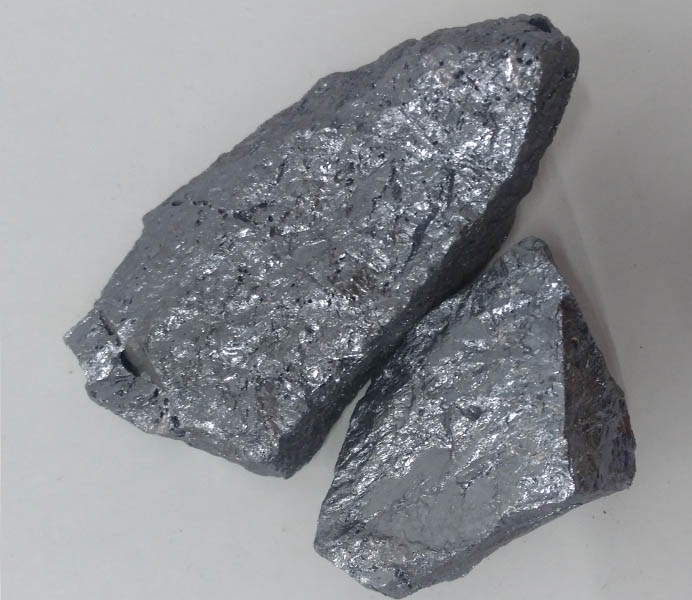
What are the applications of silicon metal?
Silicon metal has two major applications: one is for polysilicon production, and the other is for organosilicon manufacture.
Metallurgical-grade silicon (silicon metal) is further refined. It is first ground into fine powder and mixed with hydrogen chloride (concentrated hydrochloric acid). The mixture is then heated at 300°C in a fluidized-bed reactor to produce trichlorosilane, a liquid silicon compound, together with silicon tetrachloride as a by-product. Undesirable elements such as iron, aluminum, boron and phosphorus are removed by fractional distillation. Afterwards, trichlorosilane is vaporized in hydrogen at 1,000°C. Chlorine recombines with hydrogen to form hydrogen chloride, while the remaining silicon is deposited on electrically heated ultra-high-purity silicon rods to obtain ultra-pure elemental silicon. Depending on end uses, solar-grade polysilicon can reach a purity of 7–9 nines (99.999999%), and electronic-grade polysilicon can reach 12 nines. Both grades have seen their purity improved by 2–3 orders of magnitude compared with ten years ago.
For organosilicon production, ground fine silicon metal reacts with hydrochloric acid and methanol to form methylchlorosilanes, among which dimethyldichlorosilane is the primary component. It is then converted into octamethylcyclotetrasiloxane (D4). Subsequent chemical reactions such as addition and condensation produce organosilicon products including silanes, silicone fluids and silicone rubber.